

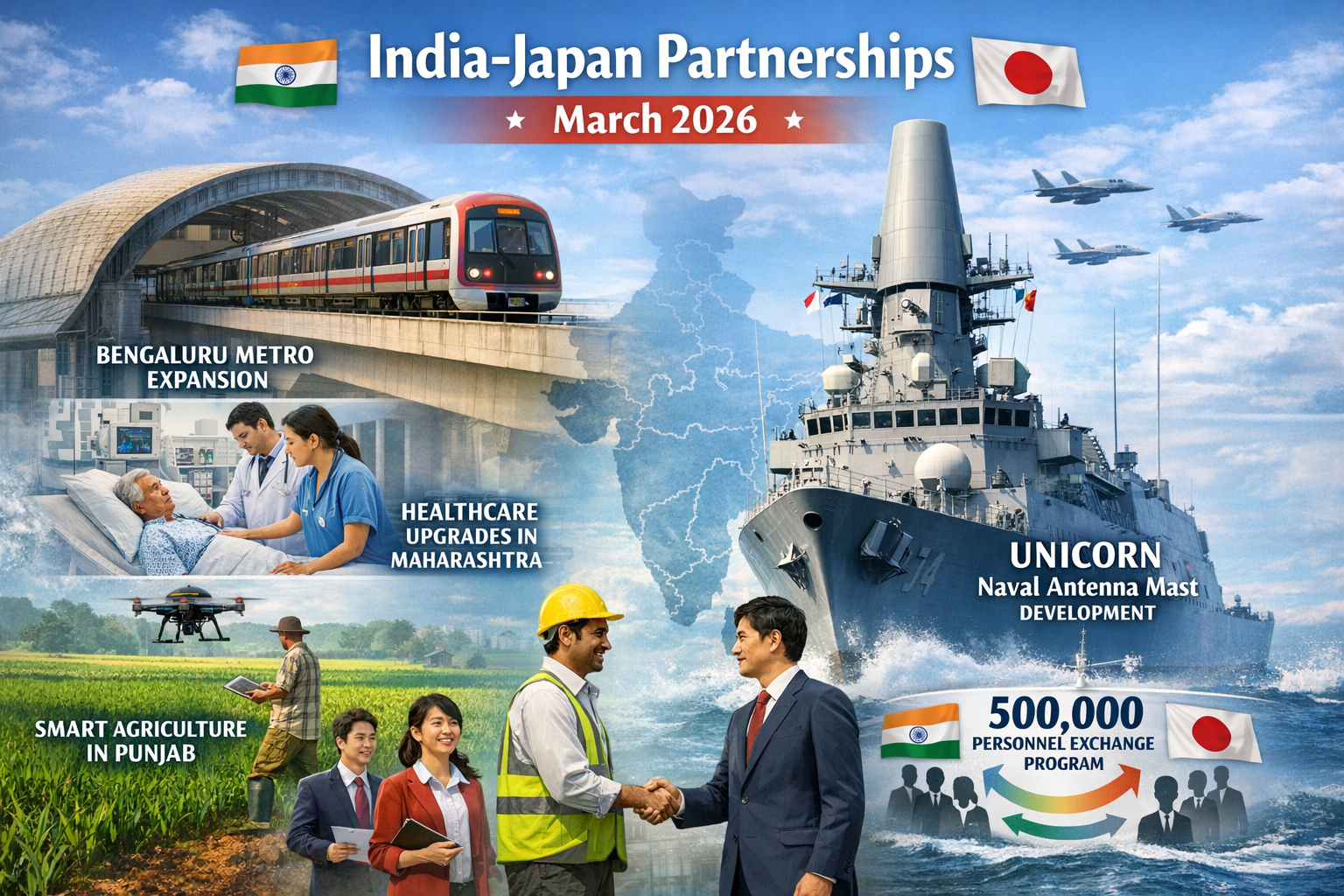

Welcome to WordPress. This is your first post.One of the most significant outcomes of the recent engagement is a ¥275 billion (approx. $1.7 billion) Official Development Assistance (ODA) package extended by Japan.
This funding will support multiple critical sectors:
1. Bengaluru Metro Expansion
A major portion of the funding is allocated to Bengaluru Metro Phase 3, aimed at easing traffic congestion and improving urban mobility. The project includes:
- ~45 km of metro lines
- 30+ stations
- Improved airport connectivity
This initiative is expected to significantly reduce pollution and enhance economic productivity in one of India’s fastest-growing tech hubs.
2. Healthcare Upgrades in Maharashtra
Japan’s ODA will also fund healthcare infrastructure improvements in Maharashtra, focusing on:
- Advanced medical facilities
- Better access to public healthcare
- Strengthening pandemic preparedness
This reflects a growing shift in India–Japan cooperation toward social infrastructure and human development.
3. Smart Agriculture in Punjab
Another key area is agriculture modernization in Punjab, where Japanese support will help:
- Introduce smart farming techniques
- Improve irrigation efficiency
- Boost crop productivity through technology
This aligns with India’s broader push toward agri-tech and sustainable farming.
⚓ Defence Collaboration: The UNICORN Mast Project
India and Japan are also advancing their defence partnership with the co-development of the UNICORN (Unified Complex Radio Antenna) mast.
What makes UNICORN important?
- Advanced stealth antenna system for naval ships
- Integrates multiple communication systems into one structure
- Enhances operational efficiency and reduces radar visibility
The project represents a major step in joint defence production, with India contributing to manufacturing while Japan provides cutting-edge technology.
This collaboration is particularly significant in the context of the Indo-Pacific region, where both nations share strategic concerns and security interests.
👥 Strengthening People-to-People Ties
Beyond infrastructure and defence, India and Japan have set an ambitious goal:
🎯 500,000 Personnel Exchange in 5 Years
This includes:
- Skilled workers
- Students
- Professionals across sectors
The initiative aims to:
- Address Japan’s workforce shortages
- Provide global opportunities for Indian talent
- Strengthen cultural and economic ties
This marks a shift toward a more integrated and people-centric partnership.
🌏 Strategic Implications: Why This Matters
These developments highlight three major trends in India–Japan relations:
1. From Aid to Strategic Investment
Japan’s ODA is no longer just financial assistance—it’s targeted, strategic, and future-focused.
2. Defence Ties Enter a New Phase
With projects like UNICORN, the partnership is evolving from cooperation to co-development and co-production.
3. A Shared Indo-Pacific Vision
India and Japan are aligning closely on:
- Regional security
- Supply chain resilience
- Counterbalancing geopolitical risks
🔮 The Road Ahead
The March 2026 agreements underline a clear message:
India–Japan relations are entering a more mature, multi-dimensional phase.
With collaboration spanning:
- Infrastructure
- Defence technology
- Human capital
…the partnership is set to play a crucial role in shaping the future of the Indo-Pacific region.
✍️ Final Thoughts
India and Japan are no longer just economic partners—they are becoming strategic co-creators of the future.
As these projects unfold, their impact will be visible not only in metros, farms, and hospitals—but also in global geopolitics and regional stability. Edit or delete it, then start writing!

Leave a Reply